

Published by Driven By Vintage · Guildford, UK · Vintage Austin J40 Specialists
Introduction
Some toys are just toys. And then there is the Austin A40 pedal car — better known to collectors as the Austin J40 — a miniature machine with a story so extraordinary, so deeply human, that even today it stops collectors in their tracks.
The Austin J40 was not designed in a vacuum. It was born directly from one of Britain’s most beloved post-war road cars — the Austin A40 Devon — and the connection between the two runs far deeper than just their shared bodylines. To understand why the Austin A40 pedal car is one of the most sought-after vintage collectibles in the UK today, you first need to go back to post-war Britain. Back to a country rebuilding itself from rubble, to a car company with a bold idea, and to a group of men in the Welsh valleys who turned that idea into something unforgettable.
This is the story of how a real road car became a pedal car legend.
Post-War Britain and the Birth of the Austin A40
The year is 1948. World War Two has been over for three years, but Britain is still living through its aftermath. Rationing continues. Bombsites scar city centres. Yet amid the austerity, a quiet optimism is stirring — and nowhere is that optimism more visible than on British roads.
The Austin A40 arrives in 1948 as one of the first genuinely new post-war British family cars. Built at Austin’s Longbridge factory in Birmingham, it is a revelation. Independent front suspension, a smooth 1.2-litre engine, and styling that borrows confidently from American influences — clean lines, a low roofline, chrome details that catch the light.
For working British families, the Austin A40 Devon and its sibling the Dorset represent something more than transport. They represent progress. Recovery. A future worth looking forward to.
It is exactly this spirit — optimistic, forward-looking, unmistakably British — that Austin Chairman Leonard Lord wants to capture. Not just for adults on the road. For children too.
Leonard Lord’s “Little Idea”: The Austin J40 is Born
Leonard Lord’s vision is simple but brilliant: build a pedal car so faithful to the real Austin A40 that a child sitting behind its wheel would feel like a genuine motorist.
Not a cheap tin toy. A real miniature car.
The design brief falls to Austin employee Jim Blaikie, whose task is to create a scaled-down version of the A40 Devon — complete with working headlights, a proper horn, chrome bumpers, a realistic dashboard with speedometer and rev counter, and opening bonnet. Every detail that makes the A40 special on the road must be present in miniature.
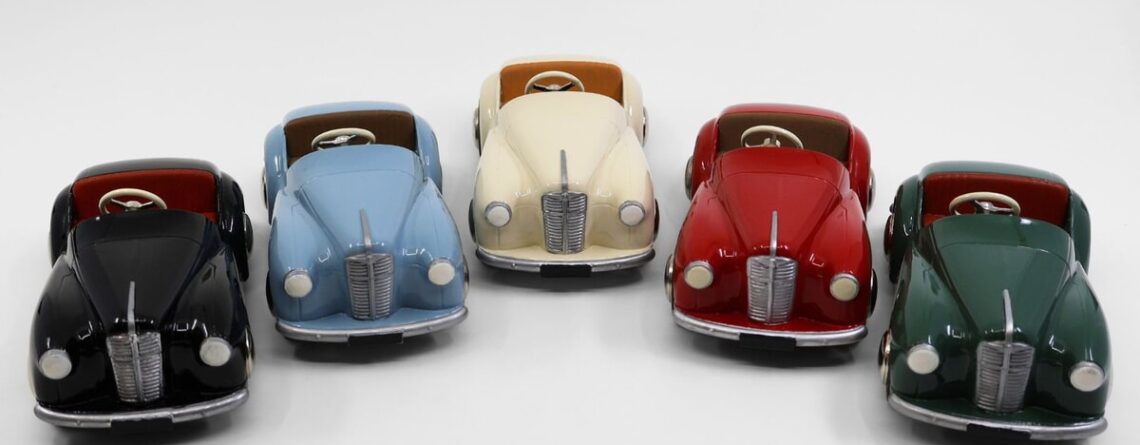
What Blaikie produces is extraordinary. The Austin J40 pedal car mirrors the A40’s bodylines with remarkable accuracy. The same sweeping front wings. The same upright grille. The same proportions that make the full-sized A40 so recognisable. Sat beside each other, the resemblance between the real car and its pedal-powered twin is unmistakable.
But where the J40 would be built — and who would build it — is the part of this story that makes it truly unforgettable.
The Bargoed Factory: A Social Employment Project Like No Other
In 1949, Austin establishes the Austin Pedal Car Factory in Tir-y-Berth, Bargoed, deep in the South Wales coalfields.
This is no ordinary manufacturing decision.
The South Wales valleys in the late 1940s are home to thousands of former coal miners — men who have spent their lives underground and paid a devastating price for it. Black lung disease, formally known as pneumoconiosis, has rendered many of them unfit for heavy work. They are proud, skilled men with no viable employment.
Leonard Lord sees an opportunity to do something remarkable. The Austin J40 factory at Bargoed is set up specifically as a social employment project for miners declared 100% disabled. Men who could no longer go underground could work in a clean, safe factory environment, building something with their hands that required precision and care — but not physical brute force.
The workforce grows from just 50 men to over 200. Every single factory floor worker is designated 100% disabled. The raw materials — steel pressing, mechanical components — come partly from scrap and surplus from Austin’s Longbridge operation, repurposed and given new life in Wales.
What these men produce is not just a toy. It is craftsmanship. Pride. Purpose.
The J40 in Detail: What Makes It So Special
Understanding why the Austin J40 pedal car commands prices of £4,000 to £13,000 among collectors today requires appreciating just how seriously it was built.
Each J40 is constructed from pressed steel — the same material used in full-sized cars of the era, not the thin-gauge sheet metal used in cheaper toys. The bodywork is painted in proper automotive colours: Clarendon Red, Opaline Green, Danube Blue, and Cream — the same palette available on the real Austin A40 and A50.
The level of detail is remarkable:
- Working horn and headlights, powered by batteries housed in a case under the bonnet
- Chrome bumpers and hub caps, faithfully reproduced from the full-sized car
- A detailed dashboard featuring a clock panel, speedometer, and rev counter
- A proper upholstered seat in colours coordinated with the bodywork
- Pedal-driven rear axle engineered for smooth, reliable operation
The J40 is built to last generations — and the evidence bears this out. Examples produced in Bargoed between 1950 and 1971 are still pedalling today, more than 70 years later.
Production ran until 1971, by which time 32,098 Austin J40 pedal cars had been manufactured — each one signed off by the hands of Welsh miners who took their craft seriously.
The Rarest of All: The Austin Pathfinder
Before the J40 came its predecessor, the Austin Pathfinder — produced for just one year in 1949.
Based on the 1930s Austin Seven Racer rather than the A40, the Pathfinder is the original Austin pedal car. With only approximately 3,100 ever made, finding one in good condition today is extraordinarily rare. Examples in original or restored condition regularly exceed £7,000–£8,000 — and exceptional examples considerably more.
The Pathfinder and J40 were briefly manufactured alongside each other before factory space was needed to fully commit to J40 production. Their brief coexistence makes cars from that transitional period particularly fascinating to collectors.
From the Goodwood Revival to Investment Asset
The Austin J40’s status as a collector’s piece is not simply nostalgic. It is financial.
In 2024, the Hagerty Bull Market list — one of the most respected guides to appreciating classic vehicles — identified the Austin J40 as a car worthy of serious collector investment. Rare, original, low-mileage examples have been appreciating steadily, driven by a combination of genuine scarcity, historical significance, and growing international awareness.
Every year at the Goodwood Revival, the Settrington Cup — a J40 race for children — draws enormous crowds and significant media attention. The race keeps the J40 alive in the public consciousness and introduces new generations to the car’s charm.
For serious collectors, the key variables that determine value are:
- Originality — original paint, original upholstery, and original components command the highest premiums
- Provenance — documentation, chassis numbers, and verifiable history
- Condition class — from fully restored “Premier” examples to original-patina “barn find” cars
- Colour — certain colours such as Danube Blue are rarer and more desirable than others
- Variant — Pathfinder examples are significantly rarer than J40s
The Connection That Brings It Full Circle
Stand a genuine Austin A40 Devon next to an original Austin J40 pedal car and the relationship is immediately, viscerally obvious.
The same grille. The same sweeping front wings. The same proportions that defined British family motoring in the early 1950s. One carries adults on real roads. The other carries children on driveways and living room floors. But both carry the same DNA — the same Austin identity, the same post-war optimism, the same commitment to quality that defined British manufacturing at its best.
When Leonard Lord commissioned Jim Blaikie to miniaturise the A40, he could not have imagined that 75 years later, people would be paying thousands of pounds for pristine examples of his “little idea.” He could not have imagined Goodwood Revival crowds three deep to watch children race them. He could not have imagined collectors across the UK, Europe, and beyond searching specifically for original, unrestored examples with the right chassis numbers and factory documentation.
But he did imagine that a child behind the wheel of an Austin J40 would feel something real. Something worth remembering.
He was right.
Find Your Austin J40 at Driven By Vintage
At Driven By Vintage, based in Guildford, we specialise in sourcing and selling authentic, verified Austin J40 pedal cars and Austin Pathfinders from the 1950s and 1960s.
Every car in our collection is:
- Verified for authenticity through chassis numbers, construction details, and provenance documentation
- Honestly described — you see the actual car, never stock images
- Personally delivered across the UK, with free viewing appointments available at our Guildford location
- Backed by a 30-day money-back guarantee
Whether you are a seasoned collector searching for a specific colour or condition class, a restorer looking for an original-parts car to work on, or simply someone who remembers these cars from childhood and wants to own a piece of that history — we are here to help you find exactly the right J40.
👉 Browse our current Austin J40 collection
👉 View available Austin Pathfinders
👉 Contact us with a specific enquiry
Frequently Asked Questions
What is an Austin A40 pedal car? The Austin A40 pedal car — officially known as the Austin J40 — is a children’s pedal car manufactured in Bargoed, Wales between 1950 and 1971. Modelled closely on the Austin A40 Devon road car, it was built from pressed steel with working lights, a horn, chrome bumpers, and a detailed interior. Today it is one of the most collectible vintage pedal cars in the UK.
How much is an Austin J40 worth? Values vary significantly by condition, originality, colour, and provenance. Restored examples typically range from £4,000 to £7,000. Original, unrestored cars with strong provenance can reach £11,000–£13,000 or more for exceptional examples.
What is the difference between an Austin J40 and an Austin Pathfinder? The Pathfinder (1949) was the original Austin pedal car, based on the Austin Seven Racer, with only approximately 3,100 made. The J40 (1950–1971) followed and was based on the Austin A40 Devon road car. The Pathfinder is significantly rarer and commands higher prices.
Where were Austin A40 pedal cars made? All Austin J40 pedal cars — inspired by the Austin A40 road car — were manufactured at the Austin Pedal Car Factory in Tir-y-Berth, Bargoed, South Wales. The factory was staffed entirely by miners declared unfit for underground work due to industrial lung disease.
How do I verify if an Austin J40 is genuine? Authentic J40s can be verified through chassis numbers stamped on the body, original factory construction details, period-correct components, and paint colours matching the original Austin palette. At Driven By Vintage, every car comes with full authenticity verification and documentation.
Driven By Vintage — Authentic Austin J40 Pedal Cars For Sale UK Based in Guildford · UK-wide personal delivery · 30-day returns drivenbyvintage.com
Leave a Reply